
Live demo · Lead Scoring

From enquiry to priority — in one step.

Lead Scoring rates incoming enquiries with AI, explains every rating and moves them through a sales pipeline. Open for you to try, with your own prompt and your own model.

  • Free to try
  • No installation
  • Data deleted after 7 days

The path of a lead

Four stages, no black-box magic. Whatever the model decides is readable on the lead afterwards.

  1. Capture the enquiry

    An incoming message is created as a lead — with its source (LinkedIn, Xing, FreelancerMap, Gulp, email) and the original text.

  2. The model rates it

    Your scoring prompt goes to the chosen model together with source and message. One call, one result, cost logged.

  3. Class and reasoning

    What comes back is exactly one of four fixed classes plus a written rationale. No free-form scale, no invented categories.

  4. Pipeline

    The lead moves through seven states from New to Won. Every change is recorded in the activity history.

The seven stages — schematic

  1. New
  2. Qualified
  3. Contacted
  4. In conversation
  5. Proposal sent
  6. Won
  7. Lost

The status is set on the lead itself; every change is recorded in the activity history.

What ends up on the lead

An example from the demo: message, rating with reasoning, and the status you set yourself.

M. Behrendt · Beispiel Logistik GmbH

Received 12 Jun 2026, 09:14 · created 3 minutes ago

FreelancerMap

Message

We are looking for support at short notice to replace our order management system. The existing system runs on Java 8; the plan is to move to Spring Boot. Budget has been approved internally, ideal start in August. Remote possible, two days on site per month.

Hot 12 Jun 2026, 09:17

The model's reasoning

A concrete, internally approved need with a clear time frame and a matching technology stack (Java, Spring Boot). The enquiry comes straight from the department and names both budget and start date — high probability of closing, immediate contact recommended.

19 of 20 scorings left today.
Status New Activity: Scored · Hot (1,284 tokens)

What you see — and what runs underneath

The demo is not a prototype with a façade. On the left, what happens in the browser; on the right, what carries it technically.

In the browser Underneath
The score appears on the lead after a few seconds. Function calling against a curated model allow-list — only providers with a clear no-training policy. Failure paths are tested, not assumed.
Below the score it says “19 of 20 scorings left today”. An enforced daily quota per account plus a global budget cap in US dollars. AI consumption cannot run on unnoticed.
The dashboard shows score distribution and funnel. The same operations are exposed as Prometheus metrics: requests, latencies and AI consumption, visible in Grafana dashboards.
“Delete account” asks for a confirmation word — next to it sits “Export data”. The export delivers profile, leads and activities as versioned JSON (access and portability, Art. 15 and 20). Deletion removes the account and everything attached to it — leads, activities, tags and issued tokens via database cascade (Art. 17), with no residual personal data left behind.
You are never logged out unexpectedly while working. JWT with access and refresh tokens, rotation on every refresh, refresh tokens hashed and revocable at any time.

What we see in operation

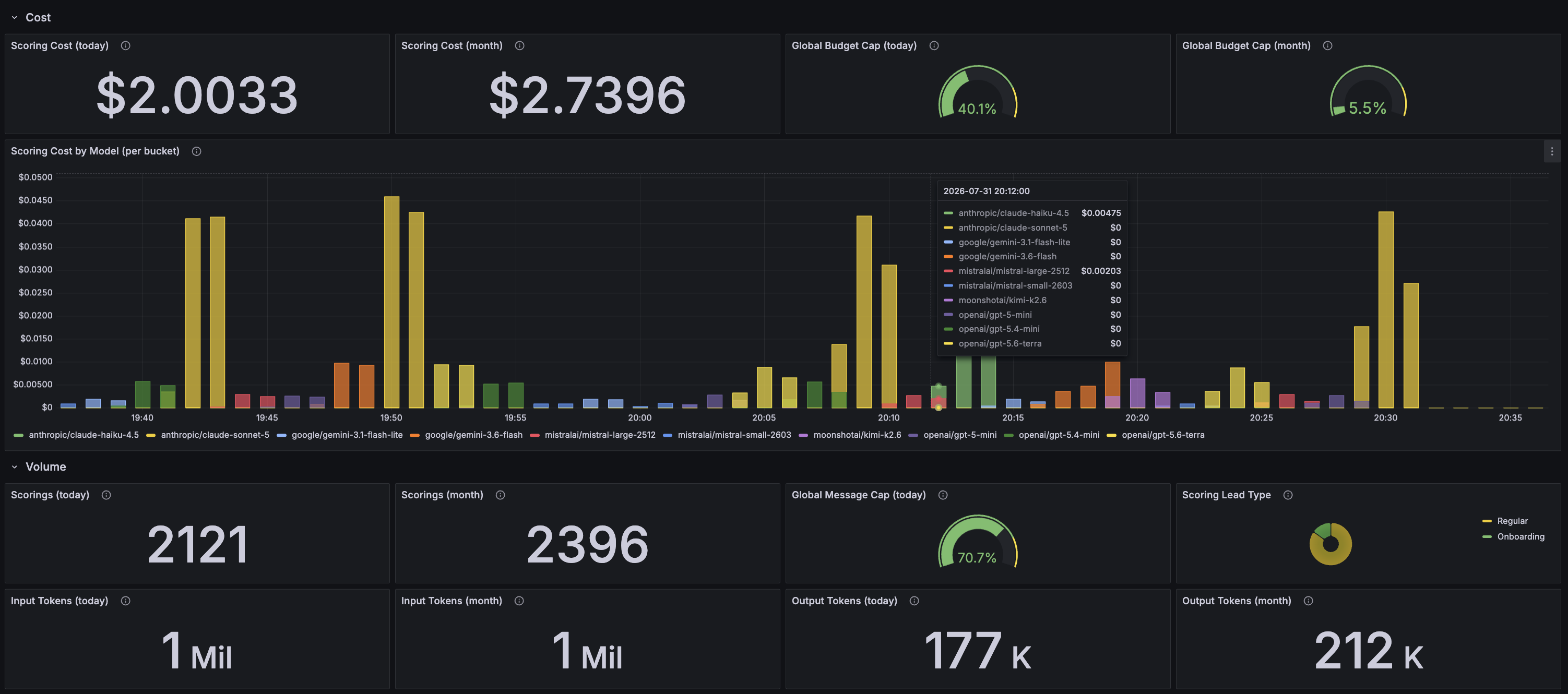
The demo does not run blind. The same operations you see in the dashboard are exposed as metrics and come together in Grafana.

Grafana dashboard of the lead scoring demo: scoring cost, budget utilisation, cost per model over time, plus scorings and tokens for day and month
From a load test of this demo — the dashboards are not part of the public access.
  • Cost per model and time window, not just as a grand total
  • Budget and volume cap utilisation at a glance
  • Consumption by scorings and tokens, split by day and month

Where lead scoring fits

Anywhere more free text arrives than anyone can read properly.

Project marketplaces

Pre-sort listings from FreelancerMap or Gulp instead of reading each one — the fitting ones first.

LinkedIn and Xing

Separate genuine enquiries from bulk outreach before time goes into the wrong ones.

Contact form

Prioritise incoming website enquiries before anyone even opens the inbox.

Sales inbox

Mark advertising and cold outreach as such automatically instead of clearing it out by hand every day.

Recruiting

Pre-qualify unsolicited applications against a requirement profile — with a reasoned classification.

Partner enquiries

Sort reseller and partnership enquiries by fit and volume rather than by order of arrival.

The pattern transfers. Free text in, one fixed class plus reasoning out, then a traceable status history — the same carries ticket triage, pre-sorting of quote requests or inbound document classification. Lead scoring is the example, not the limit.

Try it yourself in three steps

No sales call first, no demo appointments.

1 · Register

Confirm your email, done. Your data space is separate from everyone else's — you only ever see your own leads.

2 · Run the setup

A short assistant walks you through model and prompt — with templates for IT freelancing, creative services and trades — and finishes by rating a few curated example enquiries live. After that your first lead looks just like the one above.

3 · Score your own leads

Then your own enquiries: pick the source, paste the original text, create. Scoring runs automatically on creation — within your daily quota, and repeatable at any time.

  • Daily quota
  • Budget cap in US dollars
  • Rate limiting
  • Metrics and dashboards
  • Data export
  • EU hosting

Ground rules for the demo

So it is clear what you are getting into.

No real personal data

Use example texts or anonymised enquiries. The demo is built for trying out, not as a production system.

Deletion after 7 days

The data you create in the demo — leads with their ratings and history — is deleted automatically after seven days. Your account stays; you can delete it yourself at any time.

Limited quota

Each account has a daily limit on ratings. That keeps AI costs capped — and shows in passing how the limit behaves in the product.

Your use case, the same engineering.

Lead Scoring is only the example. What transfers is not the use case but the way it is built: a clean backend, an encapsulated AI layer, traceable costs and GDPR from day one. Which AI feature your product needs is what the first call is for — the “Backend + Frontend” package delivers it with full source code, from €22,500 and 6–8 weeks.